
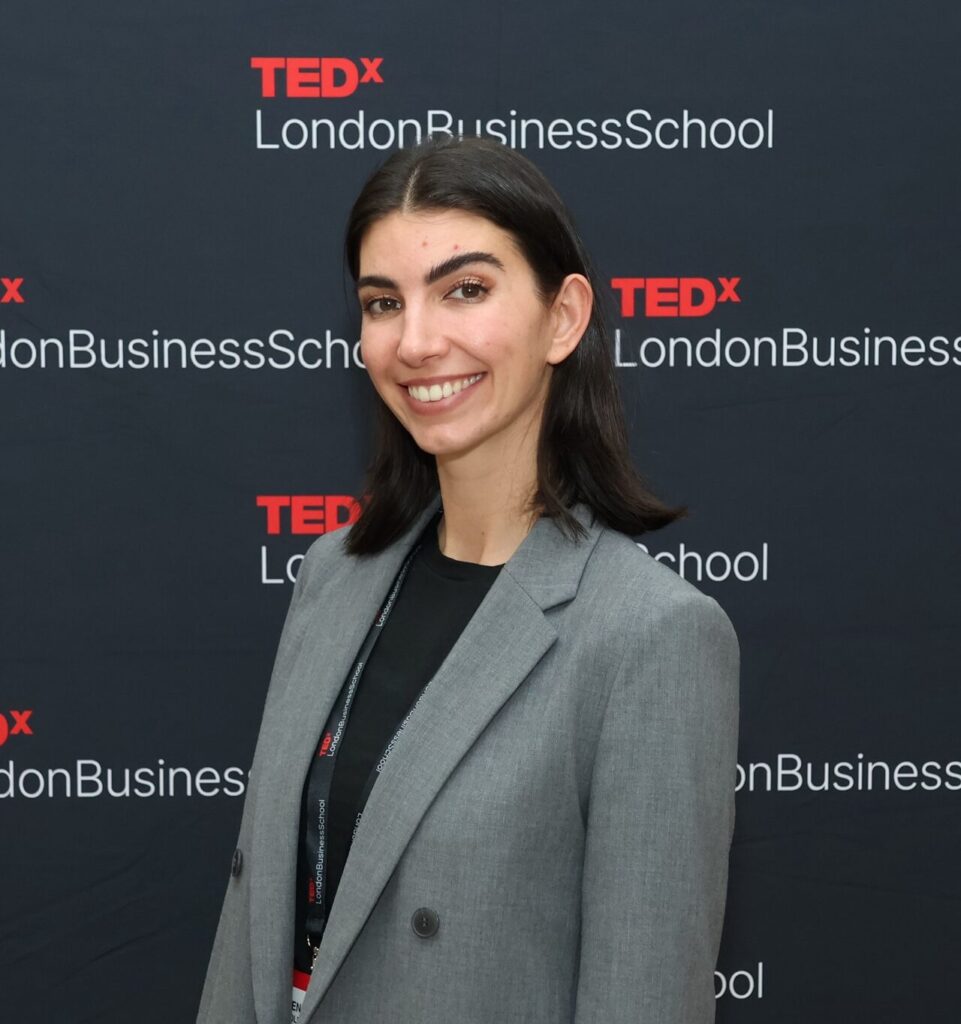
By Denira Coleman, MBA2027
I recently found myself back on stage, though not in the way one might expect from a former professional opera singer.
There were no costumes, no conductor, and no libretto. Instead, there was an idea worth spreading: a conversation about artificial intelligence, creativity, and what it fundamentally means to be human.
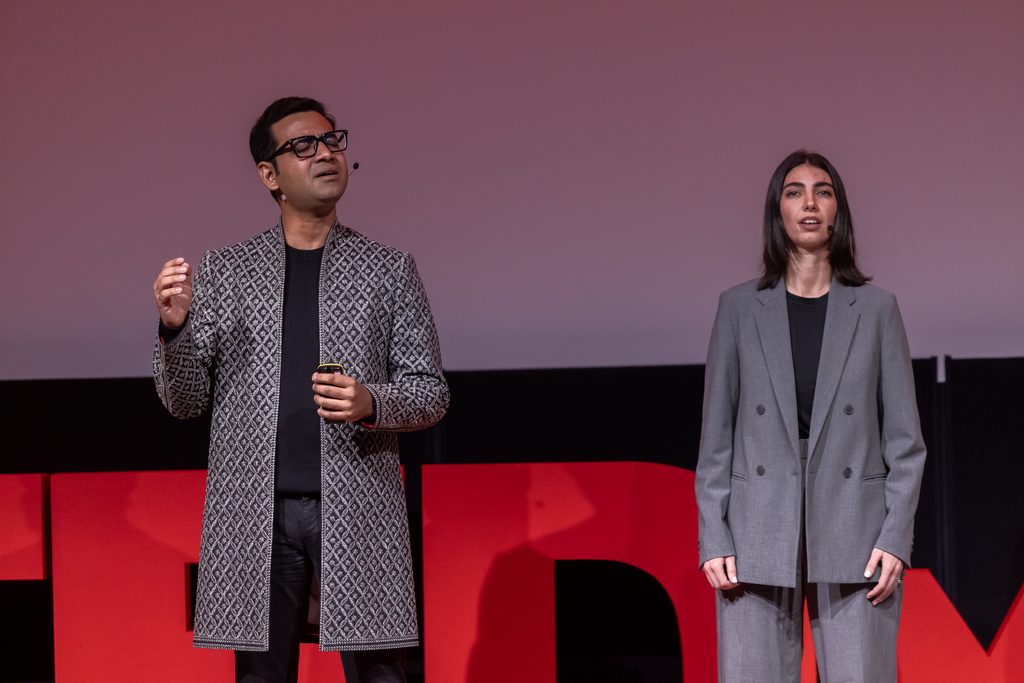
Earlier this year, I had the privilege of speaking at TEDxLondonBusinessSchool alongside my co-speaker, Aritra (Ari) Sutradhar, as part of the conference’s 2025 theme, Spaces. Together, we explored a question that feels increasingly urgent in today’s world:
Will AI replace human creativity?
For me, the experience felt unexpectedly full circle.
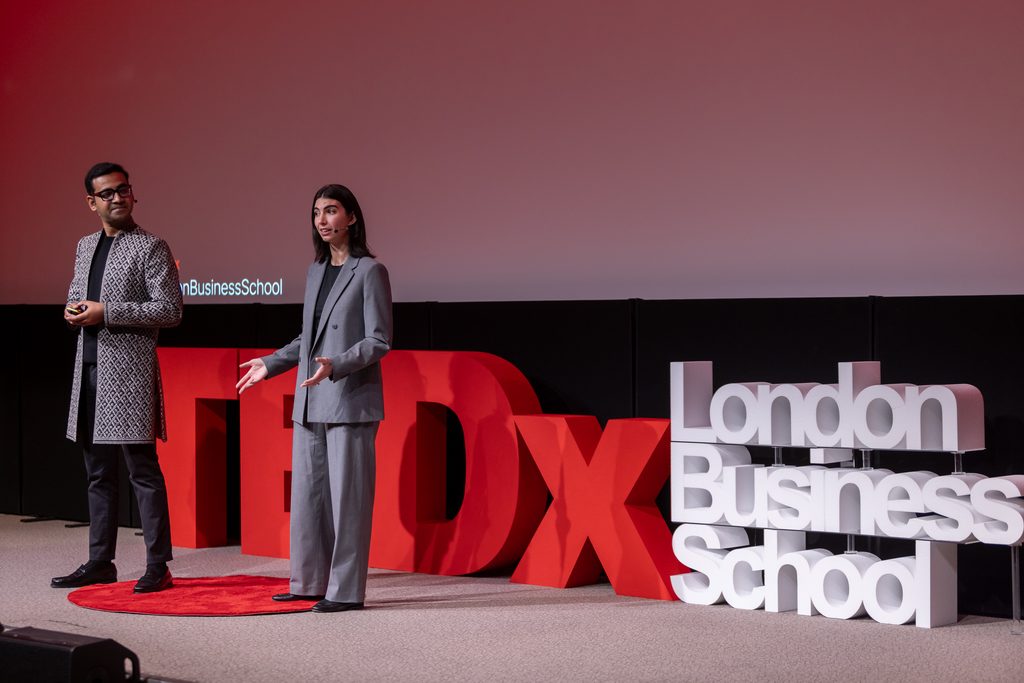
I have spent over a decade performing on operatic stages around the world. Throughout my career, my voice has primarily existed in artistic spaces: theatres, concert halls, rehearsal studios, and storytelling through music. Yet standing on the TEDx stage, I realised I was using that same voice in an entirely different way, not only to perform, but to illustrate a broader societal and business question about technology, creativity, and the future of human expression.
That evolution, from opera singer to MBA student discussing AI on a TEDx stage, felt not only surreal and special, but significant.
Ironically, the talk itself began long before the TEDx application process.
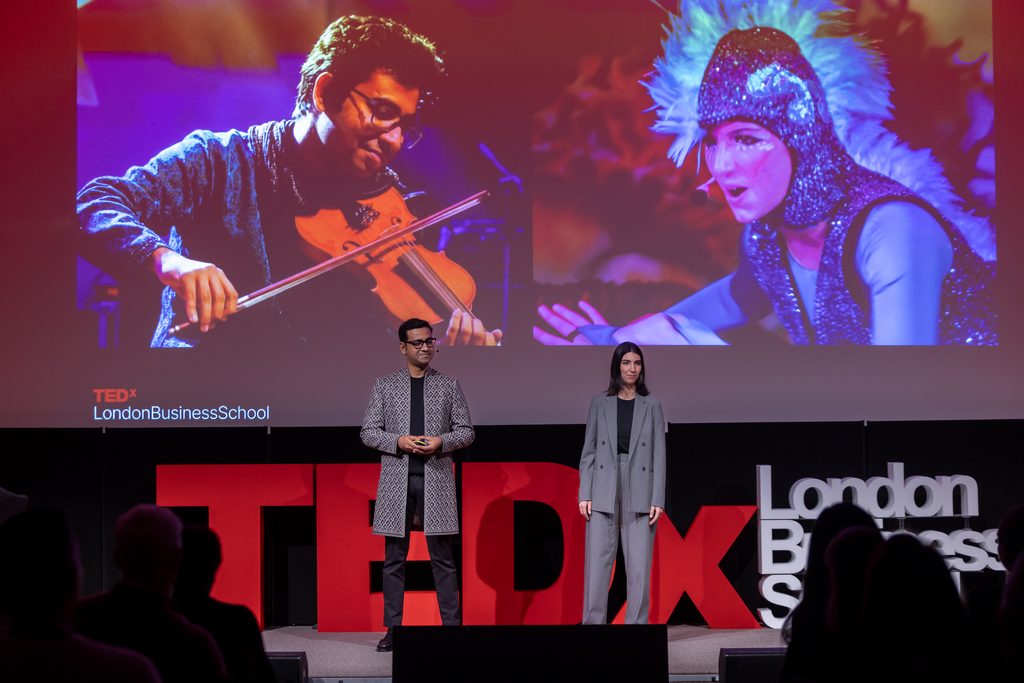
Before either of us joined London Business School, Aritra and I found ourselves discussing machine-generated music and how rapidly evolving technologies might reshape creative industries. Coming from entirely different musical traditions, mine rooted in Western classical opera and his in Hindustani classical music, we were fascinated by the same underlying question: if AI can learn the patterns of creativity, what remains uniquely human?
That question eventually became the foundation of our talk.
The TEDx process itself was far more rigorous than many people realise. Student speakers go through multiple rounds of applications, interviews, an audition talk, and then months of coaching, rewrites, rehearsals, and refinement. Every line, transition, musical phrase, and silence was intentional.
But somewhere between the rewrites and rehearsals, something shifted.
I remember the first time we fully put the talk together in rehearsal. For the first time, the argument stopped being theoretical and became emotional. We realised we had something genuinely special.
One of the most meaningful moments of the talk came when we brought our two musical traditions together live on stage. Aritra performed an unaccompanied Hindustani classical alaap, while I responded with an operatic Bellini phrase. Two traditions separated by geography, culture, and centuries of history, yet united by the same fundamentally human instinct: to express emotion through sound.
That moment ultimately captured the essence of the entire talk.
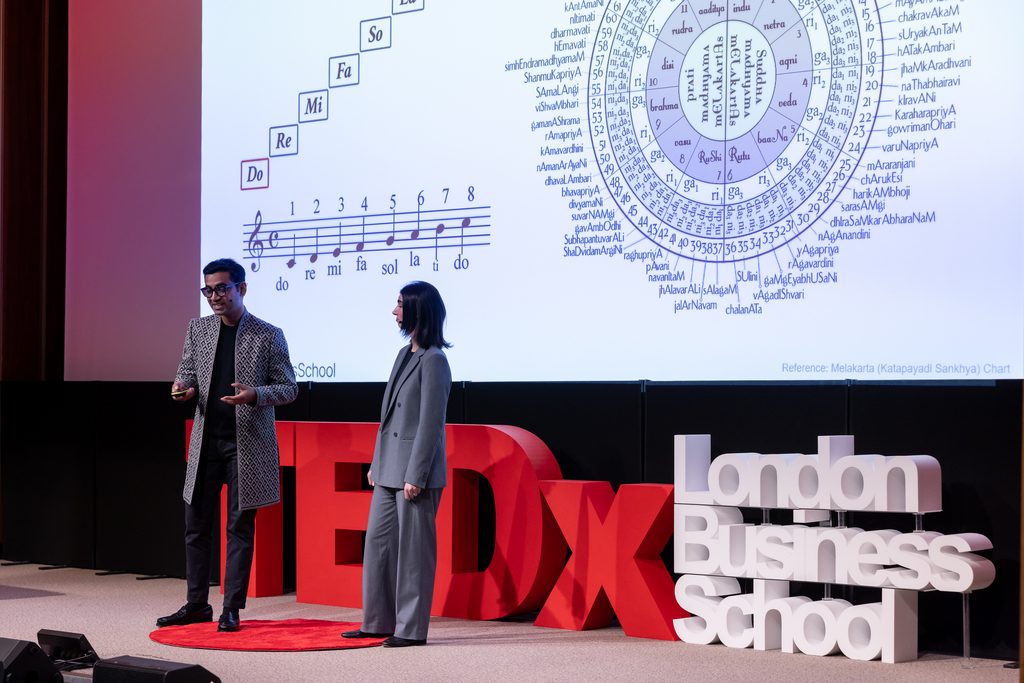
Throughout the presentation, we explored how AI learns patterns from vast amounts of existing creative data. In music, patterns are everywhere: scales, harmonies, recurring chord structures, emotional resolutions. As we argued on stage, once creativity becomes pattern-based, it becomes data and once it becomes data, it becomes replicable.
And that is precisely what makes AI simultaneously fascinating and unsettling.
At the beginning of the talk, we played a fully AI-generated piece of music and asked the audience whether they found it emotionally moving before revealing that no human composer or singer had created it. The reaction in the room reflected many of the conversations currently happening across the creative industries: awe, curiosity, discomfort, excitement.
But ultimately, our conclusion was not one of fear.
The more deeply I engage with AI, the less convinced I become by simplistic narratives of replacement. Creativity has never existed in isolation. Every artist builds upon centuries of influence, inherited traditions, and collective human experience.
AI, in many ways, simply becomes another collaborator in that process.
Not replacing the orchestra, but adding another instrument to it.
What makes human creativity meaningful is not merely the arrangement of notes or patterns. It is lived experience. Grief, joy, memory, identity, culture, relationships, struggle, love. AI may be able to imitate the structures surrounding emotion, but it cannot yet authentically live them.
And perhaps that is where the real opportunity lies.
Rather than diminishing human creativity, AI may actually force us to become more intentional about what we value most in art and expression. It may push us to preserve the deeply human elements that cannot simply be automated: vulnerability, perspective, context, and emotional truth.
The response to the talk reinforced this beautifully. What stayed with me most was not simply that people enjoyed it, but that they wanted to continue the conversation afterwards. The talk sparked debate across technology, business, music, ethics, and creativity in ways I had not fully anticipated.
For me personally, the experience also reaffirmed something important: that the arts and business are not separate worlds. Increasingly, the most important conversations sit precisely between them.
As I continue my MBA journey at London Business School and look ahead to a future working across the arts, technology, and strategy, I suspect this conversation will only become more relevant.
And despite spending much of my life on stage already, I can honestly say there was something uniquely special about standing on a TEDx stage discussing the future of human creativity itself.
You can watch the full TEDxLondonBusinessSchool talk here.
I would genuinely love to hear your thoughts:
Can AI create something truly meaningful, or is there something that lies in our being, that which makes us fundamentally human, that cannot be replicated?