
by Zarina Kassen, MBA2027
When I arrived at LBS, I could have told you what venture capital was in one sentence. That sentence would have been correct and completely useless.
Where I’ve spent most of my life, between Kazakhstan and Hong Kong, venture capital happens somewhere. It’s just not in the water the way it is in London. Nobody I knew was raising a seed round. Nobody was arguing about whether a market was big enough to return a fund. So, when I signed up for the VC trek in March, my honest expectation was that I’d sit quietly at the back, nod at things I didn’t understand, and leave with a better sense of what questions I should have been asking.
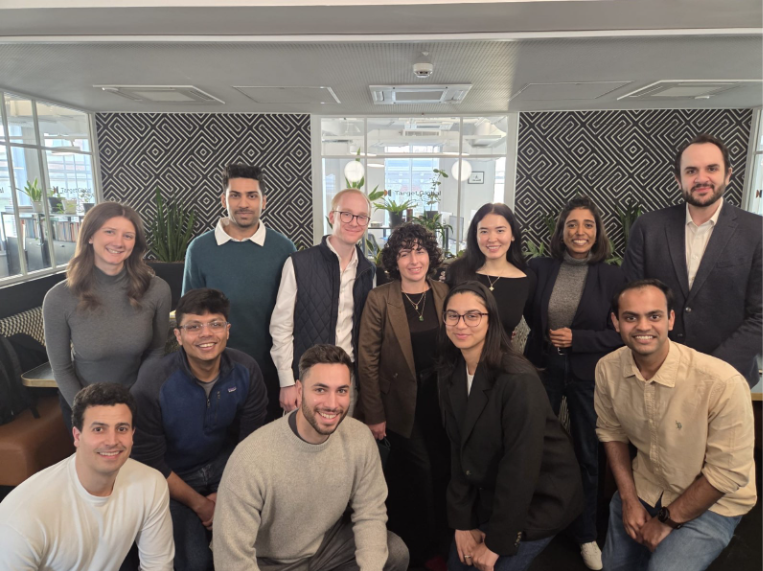
Instead, I spent a week visiting around 10 funds across London and left with roughly 40 pages of notes and a completely rewired mental model of an industry I’d been mildly intimidated by. Here’s what I kept thinking about afterwards.
They’re watching you before you know they’re watching
I found this both impressive and slightly unnerving. Several funds have built internal tools that monitor public signals: LinkedIn headcount growth, GitHub activity to spot companies hitting an inflection point before those companies have started thinking about raising. One fund described tracking the best engineering teams and watching who leaves, on the theory that good people leaving good companies are about to start something.
Another described the ideal scenario as already knowing a founder for a year before any conversation about money happens. One fund mentioned gathering twelve references on a founder, from every company that person had ever worked at.
The takeaway for anyone thinking of building something: the relationship-building starts far earlier than the fundraising does.
The maths is more brutal than I realised
One fund walked us through a healthcare startup they’d passed on. Great product, great team, and the economics on the individual customer worked. But the total market was around 300 million, and that simply wasn’t big enough to return their fund. So, they said no to a good company.
That’s not a moral judgement about the startup. It’s arithmetic. If you’re running a fund of a certain size, a company that could realistically become a solid 100-million business is a bad investment for you specifically, because it can’t move your numbers. Different funds told us versions of the same thing: one target valuation ceiling for entry, one target ownership percentage, one required multiple within a set number of years.
Once you understand that, a lot of otherwise baffling VC behaviour becomes obvious. It also completely changes how you’d read a rejection if you were a founder.
What they actually look for in founders
One fund described looking for a “spike”: someone who is a genuine 10 out of 10 at one specific thing and roughly average at everything else. Not a well-rounded 7 across the board. They gave examples: a founder building maternal healthcare whose spike was mission and lived experience; a team whose spike was simply that they executed absurdly fast and replied to messages at 2am.
Another fund had a five-point framework for scoring teams: domain expertise, product vision, sales narrative (to customers, to hires, and to investors, all three different stories), execution pace, and learning mindset. One of their actual signals for execution pace was how quickly founders reply to emails, which made everyone in our group visibly reconsider their inbox habits.
They also talk a lot about a founder’s why. Not in a soft way, but in a “we need to know this because it predicts whether you’ll still be here in year seven” way.
AI may change the investment memo, but not the coffee chat
Research and chunks of due diligence now happen dramatically faster, and several funds are building their own internal tools specifically to hold onto an edge, because the moment everyone is using the same third-party tool, that edge disappears.
But the repeated view was that venture capital remains a people business. AI can summarise a market or draft an investment memo. It cannot replace trust built over years, a candid founder reference, or the instinct you develop during a difficult conversation. Coffee chats, it seems, are safe for now.
The missed deals matter too

Some of the most memorable stories of the week weren’t about successful investments. They were about companies investors had met and passed on, because retention looked weak, or the product didn’t seem defensible, or the market looked too small. A few of those companies went on to become enormous. One fund publishes its misses. Another told us, with a slightly pained expression, about a company whose churn number scared them off shortly before it became one of the fastest-growing things in Europe.
I found it genuinely refreshing that investors talked about this so openly. Venture involves making decisions on incomplete information, which means even very experienced people will occasionally be spectacularly wrong. The better funds seem to study their misses with almost as much attention as their portfolios. Humility, I realised, isn’t just a pleasant personality trait in this industry. It’s part of the job description.
Nobody knows what they’re doing either (in the best way)
The most reassuring thing I heard all week came from a partner at one of the first funds we visited. He said, more or less: most of the time we invest in things we don’t fully understand, and our job is to understand them fast.
I’d assumed these were people who knew everything about every sector and calmly matched patterns until they got to the right answer. What they described instead was a job of constantly catching up. One fund told us they look for people who can change their mind, who’ll walk into an investment committee and shift the room’s opinion. Not people who already know everything.
If you’re sitting there thinking you don’t know enough about quantum computing or defence tech to work in venture, neither do they, until Tuesday.
The hot takes were the best part
I expected polished, media-trained answers. What we got were opinions, delivered with conviction, that frequently contradicted each other from one office to the next.
A few that stuck with me:
- SaaS is on the way out as the default exciting category, according to more than one fund. What’s replacing it: machines and factories, cities, unglamorous services such as mechanical, electrical and plumbing. The pitch was that these markets are enormous multiples bigger than software and nobody’s looking at them.
- Legal tech is over-crowded. Big players are already entrenched, and the LLM providers themselves are eating into the space. One fund said flatly they’re not looking at it.
- Utilities, telecoms with an AI layer, and old infrastructure in need of a rebuild. A refreshingly specific answer to “what’s underrated”.
- Ageing populations, from another fund. Obvious in hindsight, invisible to me beforehand.
What an MBA can take away: practical advice on entering VC
The most generous thing about the week was how specific people were when asked how to break in. Aggregating what I heard:
- Find LBS alumni who have left venture. They’ll give you honest feedback that people still in the industry can’t.
- Pick a sector and a stage first. “I want to work in VC” is not a strategy. “Growth-stage fintech in Europe” is, because it tells you who to talk to and, just as usefully, who to skip.
- Understand the fund’s model before you network. If a fund only hires at partner level, networking there is a nice conversation and nothing else. Look for funds with a track record of hiring MBAs.
- Check whether they’re raising. Headcount tends to follow fund size, so funds raising their second or third fund are where the seats are.
- Judge the portfolio, not the brand. More than one person told us a fund is only as good as its portfolio companies and that this applies whether you’re taking a job there or taking their money.

- The side door is a real door. Several people suggested founder’s associate or chief of staff roles at a strong startup are among the better entry points for MBAs. You learn the operating side, and the good funds are watching those companies anyway.
One thing that was difficult not to notice
Across a packed week of presentations, women were clearly in the minority at the front of the room. It wasn’t exactly a shocking revelation about the industry, but seeing it repeatedly made the gap feel less abstract. There were encouraging glimpses too: women building ambitious companies, women leading investments. The imbalance didn’t make me want to step back. If anything, it made me more curious, and slightly more determined to pull up a chair.
What I’m taking away
LBS didn’t hand me a textbook explanation of venture capital. It got me into the rooms where investors talked honestly about their wins, their misses, the assumptions they’ve had to abandon, and the parts of the job that remain stubbornly human.
I still don’t know whether my own path will lead into a fund, a start-up or somewhere else entirely. But the industry no longer feels like a mysterious world happening behind closed doors. After one week, those doors felt noticeably more open and that may be the best starting point I could have asked for.