
by Juan Alduncin, MBA1Y2026
That idea had been following me since I opened Kishore Mahbubani’s Living the Asian Century: An Undiplomatic Memoir on the flight over. Mahbubani, one of Singapore’s most influential diplomats, traces the city-state’s transformation from a vulnerable post-colonial outpost into one of the world’s most globally connected economies. His central argument is not that Singapore succeeded by choosing sides — between East and West, tradition and modernity, growth and sustainability — but by integrating them. It is a philosophy of deliberate synthesis.
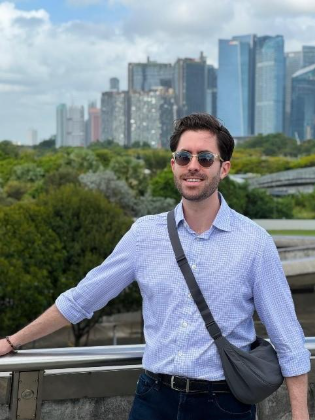
As our group stepped out into the warm February evening and the skyline lit up across Marina Bay, it was immediately clear that this was a city built on exactly that idea. A week later, I left with a deeper understanding of sustainable value chains, a renewed sense of professional direction, and a quiet conviction that the most interesting work happens at the intersections.
Sustainability as Strategy, Not Constraint
Our Global Experience centered on sustainability in global value chains — exploring how governments, companies, and financial institutions are shaping the region’s transition toward more resilient economic systems. What became apparent almost immediately was that Singapore does not treat sustainability as a compliance obligation or a cost center. It treats it as a source of competitive advantage.
A session with the Singapore Economic Development Board illustrated this clearly. Policy, investment, and industry development are deliberately co-designed to reinforce long-term resilience. The government does not wait for markets to price in externalities; it shapes the conditions under which markets operate. For anyone coming from a background in blended finance, this alignment between public intent and private capital felt familiar — and deeply instructive.
The Economy Has a Physical Foundation

Business school can sometimes feel like a place where every conversation orbits AI, fintech, or the next digital platform. Singapore pushed back on that gently but firmly. Many of the most consequential sustainability challenges unfold in sectors that work with land, water, infrastructure, and people — sectors that are anything but abstract.
Visiting Olam Agri showed how sustainability is embedded within global agricultural supply chains, where traceability, farmer livelihoods, and environmental stewardship must all be balanced simultaneously — and where trade-offs are real, not theoretical. On the same day, walking through the rooftop park of the Keppel Marina East Desalination Plant offered a different kind of lesson: how long-term infrastructure investment can transform resource scarcity, in this case water, from an existential risk into a source of national resilience.
The most layered moment came when we crossed into Johor, Malaysia, to visit Kim Loong Resources Berhad and see the palm oil value chain firsthand. Palm oil is a sector easy to caricature from a distance — either defended as an economic lifeline for millions of smallholder farmers or condemned for its environmental footprint. Being there, walking through the plantation and the milling operation, added the nuance that distance strips away. Palm oil’s extraordinary land-use efficiency compared to other vegetable oils is genuinely significant within global food systems; so are the pressures on forest ecosystems. Both things are true, and any serious sustainability framework has to hold that tension honestly.
These visits served as a reminder that the world’s economy remains deeply rooted in physical systems — and that the people working in those systems deserve more than simplified narratives.

Finance as the Connective Tissue
Running through all these visits was a common thread: finance. Capital allocation decisions shape which supply chains become more sustainable, which infrastructure gets built, and which transitions are viable at scale. A panel on sustainable finance made this concrete.
One speaker, Diana Guzman — Group Chief of Sustainability at Prudential — traced a career that began in blended finance, moved through years working in China, and eventually led to Singapore. Born in Mexico, she had built her career by following the problems that interested her, across borders and sectors, until she arrived at a role where she could work at scale.
Her story hit differently for me. As a Mexican, impact-driven professional with a background in blended finance myself, I am often asked — sometimes implicitly, sometimes directly — why I am orienting my career toward regions far from home. Diana’s trajectory offered a clear answer: because the problems and opportunities do not stop at borders, and neither should we. Working outside one’s comfort zone is not an eccentricity; for some of us, it is the whole point.

A Full-Circle Moment at the Singapore Green Finance Centre
The visit to the Singapore Green Finance Centre brought the week into focus. Our session there went beyond surface-level ESG — it was a rigorous deep dive into impact measurement: what it actually takes to build systems that can tell you, honestly and precisely, where sustainability gains are coming from and how companies can use that understanding to evolve.
That framing was immediately familiar. At the World Bank, I have spent years building and applying impact measurement frameworks — working directly with clients to strengthen their sustainability propositions, structuring private sector interventions to optimize for development and environmental outcomes, and designing investments where impact is a core objective rather than a footnote. It is granular, iterative work; it requires holding the financial logic and the on-the-ground reality in the same frame simultaneously.
In conversation with one of the Centre’s directors, and then among my peers, I found myself in the unusual position of being the practitioner in the room — explaining not just the theory but the mechanics, where measurement systems hold up under real project conditions and where they tend to break down. The classroom dynamic quietly inverted.
That is the full-circle moment I will carry from Singapore: the recognition that the work I have already done matters and points clearly toward the work I want to be part of next as an impactful contributor to sustainable economic and human development in emerging markets.
Unmistakably Itself
What ultimately stayed with me most about Singapore was something that transcends policies, infrastructure, or financial architecture. Despite absorbing global best practices — in governance, sustainability, urban design, and economic development — Singapore remains unmistakably itself. It has not been flattened into a generic global city. It reflects Mahbubani’s philosophy in practice: a society confident enough to learn from the world without losing itself in it.
If the Asian Century is indeed unfolding, Singapore offers a glimpse of what it might look like — not a world where cultures converge into indistinction, but one where societies adopt the best ideas from one another while remaining unmistakably themselves.
That seems like a model worth paying attention to — in cities, in industries, and perhaps in careers too.