
by Riaz Masters, MBA2027
Before the MBA, I spent years helping clients understand businesses from the outside. LondonCAP put me on the inside of one, and in charge of the team doing it. Here is what I learned.
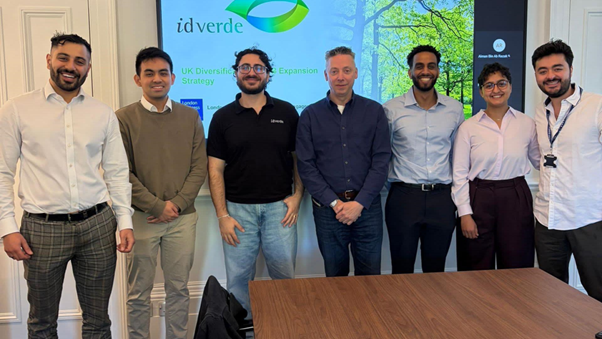
When I saw the list of LondonCAP projects for the year, one jumped out at me immediately: idverde, Europe’s leading green services provider, backed by private equity firm Core Equity Holdings. For a lot of my classmates, it was just another consulting project. For me, it felt personal.
A couple of years earlier, conducting due diligence at AlphaSights, I had helped clients understand idverde from the outside. Now I had the chance to advise it from the inside. I also had a longer-standing interest in PE value creation, and the chance to work directly with a PE-backed portfolio company on a live growth strategy was exactly the kind of experience I came to LBS to find.
I put my name down to lead the project straight away.
Why I wanted to lead
Most of my experience before the MBA had been in corporate environments, where leadership comes with both soft and hard power. You can set targets. You can manage performance. Leading a student team is completely different. You have no formal authority whatsoever. If your teammates do not want to follow your direction, they simply won’t. That reality made the team lead role more appealing to me, not less. I wanted to find out whether I could lead purely through clarity, trust, and communication.
The first client meeting set the tone
The project had been championed internally by Iñaki Aranzabal, an LBS alumnus who had experienced LondonCAP during his own MBA and loved it so much that he had pushed for idverde to get involved. Hearing that in our first meeting landed heavily on the team. We were not just doing a class project. We were standing on the shoulders of people who had done this before us, and we wanted to do it justice.
It also helped that the people across the table were taking it seriously. Our client contacts included the UK’s Managing Director and the Executive Director of Strategy, senior leaders with real decisions to make. That set the tone quickly.
The brief was genuinely ambitious: define idverde’s strategy for accelerating its growth in the UK B2B grounds maintenance market. The company had built a strong reputation in the public sector, working with local authorities across the country. Now, it was looking to build on that foundation by developing a more targeted operational and commercial approach to servicing corporate clients.
What made the work hard (and interesting)
The first thing you realise on a project like this is that the data you need rarely exists in the form you need it.
idverde and most of its competitors are privately held, which means there is limited publicly available information. On top of that, the B2B segments and commercial model we were evaluating were not yet fully mapped, so there was limited internal data to draw on either. We were starting from scratch in both directions, which meant we had to think differently and move beyond conventional approaches. Two examples stand out.
The first was geospatial mapping. We needed to understand whether idverde’s existing depot network could actually service the segments we were recommending, so instead of drawing crude radius circles on a map, we used a route-density tool to calculate realistic drive times from every depot to thousands of potential client sites across the UK. The picture that came back was compelling: the majority of priority segment sites sat within 30 minutes of an existing depot. That single finding gave the team the confidence to recommend that idverde could scale its B2B ambitions with limited infrastructure investment.
The second was getting a prospective buyer’s perspective. Facilities Managers are notoriously time-poor and difficult to reach, but we knew that understanding how commercial buyers actually make procurement decisions was not something we could answer from a desk. So we picked up the phone. We cold-called buyers across the UK, and managed to secure interviews that directly shaped our final recommendations. Hearing what a business park manager genuinely valued in a supplier, and what it actually took for them to switch providers, was insight no dataset could have given us.
None of this came from a textbook. It came from being resourceful, thinking creatively, and being willing to do things that felt unconventional.
What leading a diverse team actually taught me
My team had five people from four different countries, with very different working styles and preferences. I learned quickly that the way I like to receive information is not necessarily the way everyone else does. Some people want a quick call. Others want a detailed message they can absorb in their own time. A WhatsApp group, weekly check-ins, and pre-reading sent before every client meeting. Over time, we built a system that worked for everyone rather than one that worked for me.
The harder lesson was around ownership. There is a temptation, when you are a team lead, to over-manage. I want to see and sign off on everything. I had to resist that. Each team member owned their workstream completely. My job was to make sure the pieces connected and told a coherent story, not to do the work for them.
What I had not fully anticipated was that the right process could solve both communication and ownership at once. Midway through the project, with four workstreams running in parallel, I could feel the siloing starting. Everyone was working hard. Nobody had the full picture. So I set up a shared Trello board, one column per workstream, with each lead responsible for updating their own tasks and flagging blockers. Having a visible, shared picture of where everything stood meant people were pushing things forward on their own rather than waiting to be chased. The communication system and the ownership mindset had to work together. That Trello board was where they did.
The final presentation
Ten weeks of early morning faculty check-ins, client meetings, late nights pulling slides together, and more rounds of geospatial analysis than I care to admit, all led to one room. We stood up and delivered a recommendation-led presentation to idverde’s leadership team, and it landed.
That feeling, of having done something real and having it received seriously, was what we had worked towards. But the project grew beyond even that.
At the LondonCAP Closing Event a few weeks later, Iñaki told us he was genuinely excited to start acting on our recommendations over the next few years, and that idverde had already begun engaging LBS MiM students on a follow-on project. Somehow, that felt like the best possible outcome, not just a good grade, but something that actually continued beyond us.
What I would tell someone considering LondonCAP
Go for it. But go in knowing it is not a simulation. The client is real, the problem is real, and the constraints are real. You will not always have the data you want. You will have to make judgment calls. You will have to manage people who have no obligation to follow you.
That is exactly what makes it worth doing.
The MBA gives you frameworks, concepts, and language. LondonCAP gives you something harder to teach: the experience of doing something real, for someone who actually needs the answer.
A big thank you to Sioma Breitman Amselem, Aron Zerezghi, Richard Burton, and Iñaki Aranzabal at idverde, and to my teammates Aiman Razak, Emil Namen Leon, Gautam Unnikrishnan, and Shivani Vartak. It was a genuine privilege.